

Master Reference · Updated For Arizona Homes
Stain Removal Guides
A master lookup across stain type and material, so the treatment matches the stain instead of making the damage permanent.
Match The Treatment To The Stain
Different stains need different treatments, and using the wrong method, especially an acidic cleaner on acid sensitive stone, can turn a treatable stain into permanent etching.
This page is a master lookup across stain type and material. Each material's full guide has additional material specific notes worth reading before you treat anything.
Stain Type & Treatment
Filter by material to narrow the chart to the stains that actually affect that surface.
| Stain Type | Best For | Treatment | Avoid |
|---|---|---|---|
| Oil based (cooking oil, grease) | Most materials | Baking soda or specialty poultice, dwell time required | Do not scrub immediately, let the poultice draw the oil out |
| Hard water / mineral deposits | Most materials | Material specific descaling cleaner | Never a generic acid cleaner on marble, limestone, or travertine |
| Rust | All materials | Dedicated rust poultice | Never a wire brush or a generic rust remover, which are often acidic |
| Organic (leaves, food, algae) | Exterior stone, pool decks | Enzymatic or oxygen based poultice | Avoid bleach on natural stone |
| Etching (wine, citrus, vinegar) | Marble, limestone, travertine | Polishing powder or professional re polish | This is physical damage, not a stain, and cleaning products will not fix it |
| Mold / mildew | Grout, showers | Oxygen based cleaner | Avoid bleach as a routine solution, it breaks down sealer |
| Efflorescence (white haze) | Saltillo, quarry, slate, exterior stone | Dry brush first, then an efflorescence remover | Do not wet mop over it first, that can spread it |
Stain Or Etching?
If a spot will not lift with cleaning but the surrounding stone still looks glossy while the spot looks dull, it is likely etching, meaning physical damage rather than a stain. Etching needs re polishing, not a stronger cleaner.
How It Works
Almost every serious stain treatment on this page works the same way underneath.
How A Poultice Works
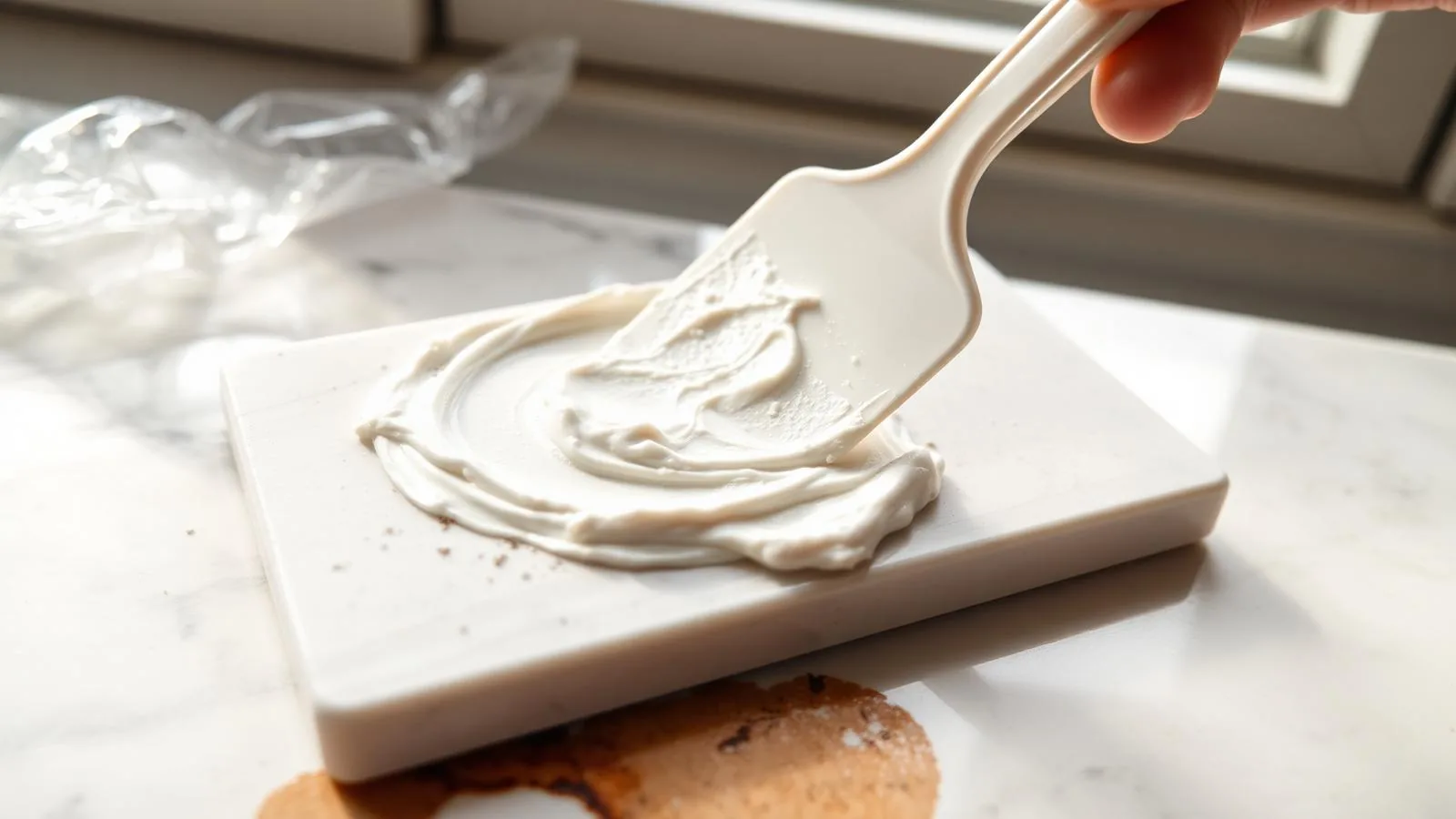
A poultice draws a stain out of porous stone by reverse absorption. The paste needs to stay damp and covered, typically with plastic wrap, for several hours to overnight in order to actually pull the stain upward out of the pores, rather than just sitting on the surface.
Why Dwell Time Is The Whole Job
Removing the poultice early stops the migration halfway, which is why a stain often looks lighter but never fully clears. Give it the full dwell time, then let it dry completely before removing it.
Why Etching Is Different
Etching is a chemical reaction that has removed surface material, not a deposit sitting inside the pores. No poultice or cleaner reaches it, because there is nothing to draw out. It is corrected mechanically by honing or polishing.
Do This, Never That
Do
- Identify whether it is a stain or etching before choosing a treatment
- Test any new product in an inconspicuous spot first
- Give poultices their full dwell time
Don't
- Use vinegar, lemon, or bleach on any acid sensitive stone such as marble, limestone, or travertine
- Scrub etching harder, since it will not remove physical damage
- Assume all stone cleaners are pH neutral without checking
Stain Removal Guides Questions
Full Care Guides
Every material and grout guide in the Resource Center, with the complete step by step care detail behind the summaries above.
Ceramic Tile Care
Glazed face, porous grout: the routine that keeps it looking new.
Read GuidePorcelain Tile Care
Near-zero absorption, but grout and polished faces still need care.
Read GuideTravertine Care
Filled vs unfilled, reseal intervals, and Arizona pool deck wear.
Read GuideMarble Care
Why etching, not staining, is marble's real problem.
Read GuideGranite Care
The water droplet test and slab-by-slab reseal frequency.
Read GuideSlate Care
Cleft texture, delamination, and breathable sealers only.
Read GuideLimestone Care
Soft, acid sensitive, and dependent on a working sealer.
Read GuideSaltillo Tile Care
Unfired clay that treats sealer as a requirement, not an option.
Read GuideQuarry Tile Care
Dense unglazed clay tile and the grout that fails around it.
Read GuideTerrazzo Restoration
Composite stone, wax buildup, and true restoration polishing.
Read GuidePool Deck Stone Care
Chlorine, UV, and the 9 to 12 month reseal window.
Read GuideGrout Cleaning & Sealing
Porosity, reseal cycles, and when grout has failed beyond cleaning.
Read GuideShower Restoration
Moisture exposure, restoration vs retile, and project phases.
Read Guide
Related Pages
Natural Stone Sealing Guides
The master sealing reference: penetrating vs topical sealers, and reseal frequency for every material in this Resource Center.
Learn moreMaintenance Schedules
Every weekly, monthly, and yearly routine on this site, consolidated into one filterable master schedule.
Learn moreCeramic Tile Care
Placeholder overview. Real content for this guide is being written by the field team and will replace this text.
Learn moreReady when you are
RESTORE YOUR STONE.
GET A FREE BID.
Design-builds, restoration projects, specialty projects, and remodels across the Valley · Family-owned and locally operated.
- Mon–Fri · 7am to 4pm
- Sat · Closed
- Sun · Closed